
On the evening of Thursday 7th July 2005 there will be a reception at the Museum of Science and Industry in Manchester (which, as can be seen from the map is centrally located). Details of one of the main exhibits is given below.
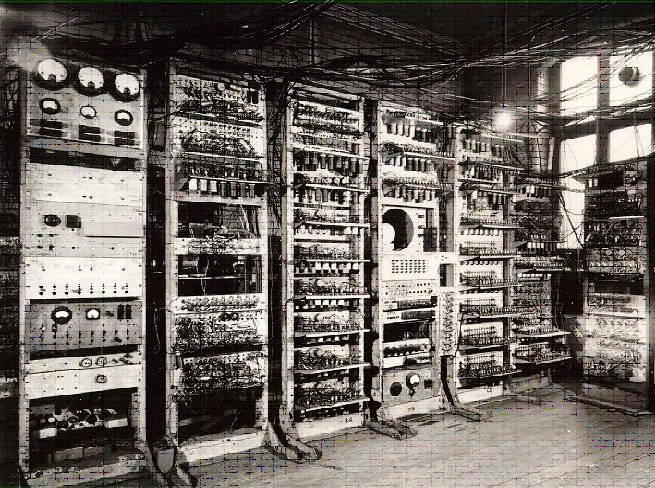 The original computer was developed as a research prototype to prove the concept
of digital storage using the cathode ray tube (CRT). The people who designed it
were Professor Freddie Williams, Tom Kilburn, and Geoff Tootill at the University
of Manchester. Alec Robinson, Dai Edwards and 'Tommy' Thomas later joined them.
The machine ran the world's first stored program at about 11.00 am on Monday 21 June, 1948.
The original computer was developed as a research prototype to prove the concept
of digital storage using the cathode ray tube (CRT). The people who designed it
were Professor Freddie Williams, Tom Kilburn, and Geoff Tootill at the University
of Manchester. Alec Robinson, Dai Edwards and 'Tommy' Thomas later joined them.
The machine ran the world's first stored program at about 11.00 am on Monday 21 June, 1948.
The computer was subsequently enhanced to include extended CRT storage, drum storage, and a multiplier unit. Ferranti Ltd then engineered the design for reliability and production in quantity, and delivered the Mark 1 Computer to the University of Manchester in February 1951.
The replica was built to mirror the state of the original as it was on 21 June, 1948. The goal was to run the replica on the 50th anniversary of the first stored program. This was achieved before a distinguished audience at 11.15am, on Sunday, June 21st, 1998.
A team of enthusiastic volunteers, led by Chris Burton, re-built the machine. Although the prototype no longer existed, the team gleaned invaluable information from Dai Edward's lab notebook, Alec Robinson's photographs and the personal recollections of Tom Kilburn and Geoff Tootill. The re-build was sponsored by ICL Ltd and supported by the University of Manchester, and the Museum of Science and Industry. People who had retired from the industry kindly donated many components.
The team used technology developed for Second World War radar and communications
equipment. The major components comprised 300 thermionic diodes (type EA50),
250 thermionic valves (mainly types EF50 and EF55 pentodes)
Power supplies: +300V, +200V, +50V, -150V, -1250V.
Power consumption: 3,500 Watts.
Clock Rate: 100 kHz (330 MHz in today's PCs)
Size: 5.23m (17 ft) long, 2.26m (7ft 4in) high Weight: 1 tonne
There were just six instruction types. Programs were loaded bit-by-bit using the push-button 'typewriter'. The first program was a test for prime numbers, and could run from seconds to hours, according to the size of the trial number. The historic first run took just a few seconds.
For further information
Read: Lavington, Simon A History of Manchester Computer, British Computer Society, 1998.
Visit: Computer50 web site: http://www.computer50.org/
CD, The Computer that Changed the World.
Last modified: 24th May 2005
