DigRepStandardsApproach
From DigiRepWiki
Contents |
Approach Taken On The Selection And Use Of Standards
Background
UKOLN, a national centre of expertise based at the University of Bath, has been asked by the JISC to take responsibility for the development and maintenance of advice on the technical standards to be used by projects funded by JISC's development programme.
The approach which has been taken is based on the recommendations of the JISC-funded QA Focus project which was provided by UKOLN and the AHDS. Following discussions with several projects and JISC staff it was acknowledged that the use of open standards can help to support the interoperability of project deliverables which is of particular importance to the JISC environment and the higher and further education communities, in light of the diversity which is encountered within this sector. However, despite the acknowledged importance of open standards, it was also recognised that the selection and use of open standards is not always easy. There is an awareness that not all open standards gain widespread acceptance and that adoption of open standards before they have proven their reliability and gained widespread acceptance can be costly (as has been seen with the experiences of the planned transition to OSI networking protocols through use of Coloured Book software in the 1980s). In addition to such issues, there is also a recognition that use of open standards may not be applicable in all contexts. For example use of open formats in areas such as word processing, spreadsheets and databases may cause problems in interoperability; in such circumstances in may be sensible to continue to make use of proprietary solutions.
A Layered Approach To Use Of Open Standards
In light of this, a layered approach to use of standards has been developed. This approach, whilst encouraging use of open standards to enhance interoperability, will permit alternative approaches if use of open standards can be shown to be too costly or difficult to implement. In such cases there will be a need to demonstrate the case for deviance from best practices.
The layered approach makes use of three layers (which is described more fully in "A Standards Framework For Digital Library Programmes" <http://www.ukoln.ac.uk/web-focus/papers/ichim05/>- a paper presented at the ichim05 conference.
This approach is illustrated below.
<img src="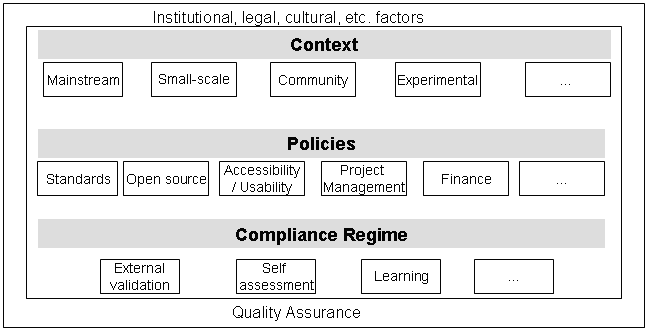 " />
" />
The layers are summarised below:
- Contextual layer: This reflects the context in which the standards are being used. Large, well-funded organisations may choose to mandate strict use of open standards in order to build large, well-integrated systems which are intended for long term use. For a smaller organisation, perhaps reliant on volunteer effort with uncertain long-term viability, a simpler approach may be more appropriate, perhaps making use of proprietary solutions.
- Policy layer: This provides a description (or catalogue) of relevant policies in a range of areas. The areas will include descriptions of standards, the topic of this paper.
- Compliance layer: This describes the mechanisms which will be used in order to ensure that development work complies with the requirements defined within the particular context. For large, public funded programmes there could be a formal monitoring process carried out by external auditors. In other contexts, projects may be expected to carry out their own self-assessment. In such cases, the findings could be simply used internally within the project, or, alternatively, significant deviations from best practices could be required to be reported to the funding body.
Application Of This Approach To The Digital Repositories Programme
The layered approach described above is a generic approach which can be applied across JISC's development programmes (and indeed more widely). The application to the Digital Repositories Programme is described below
- Contextual layer: The JISC programme manager (and associated bodies and individuals) are responsible for defining the application of the standards for projects funded by the programme and for defining reporting procedures and quality assurance processes.
- Policy layer: This document describes the technical standards which may be of relevance to the projects.
- Selection layer (note not included in above diagram): The projects themselves will be responsible for developing and documenting the technical architecture to be used. This will include the selection of relevant standards. The JISC programme manager will advise on areas in which projects can make such decisions for themselves and areas in which decisions need to be ratified (by the programme manager or by other bodies, such as a project advisory group)
- Compliance layer: The projects themselves should develop quality assurance procedures which will ensure that their technical (and other) policies are being implemented appropriately. Self assessment may be needed for internal management purposes. In addition the JISC programme manager may require notification of significant deviations from best practices. In addition to such self assessment, the JISC programme manager may chose to require additional reporting or assessment processes.
Example
An example of an implementation of this approach is given below.
This example covers use of standards for a project Web site.
- Contextual layer: The JISC programme manager may require that project Web sites should seek to implement appropriate open standards, including HTML and CSS, and require projects to document its decisions and its QA processes and to report on any significant deviations from this policy.
- Selection layer: A project may choose HTML 4 (or XHTML 1) and CSS 2.0 and to implement this using a CMS. This decision should be documented - possibly on its Web site so that not only is JISC aware of the decisions, but also the wider community, including potential other stakeholders (e.g. a service which may wish to archive the Web site).
- Compliance layer: The project's compliance regime could include systematic validation processes and audit trails to record trends. There may be legitimate deviations from best practices e.g. !PowerPoint files converted to HTML may not comply with HTML standards.

